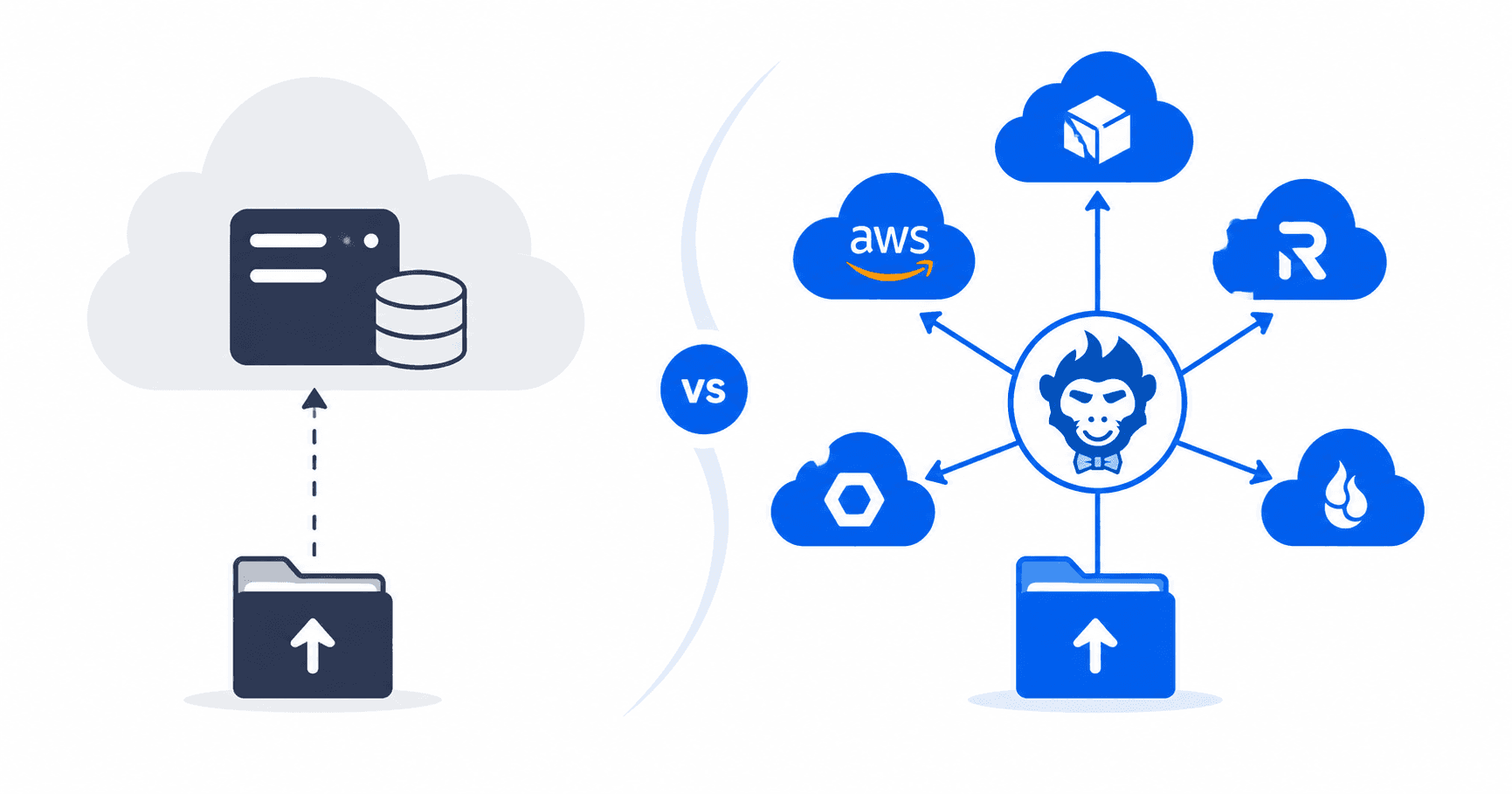
AWS Transfer Family runs about $216 to $223 a month per protocol just to keep the endpoint alive. That is before you transfer a single byte. AWS bills you hourly, non-stop, whether files are moving or sitting completely untouched. (If you want the full breakdown of how AWS stacks these charges, check out our detailed pricing guide.)
If you're an enterprise slinging terabytes around the clock, that base cost gets lost in the noise. But if you're running a smaller operation that just needs to ingest files from a handful of partners, cameras, or external vendors? It's easily one of the most expensive ways to solve the problem.
Why pay a monthly retainer for a pipe that sits empty 90% of the day?
Here are six alternatives that actually make sense for smaller teams in 2026, complete with verified pricing from each vendor. Full disclosure: we built Rilavek, so take our perspective with appropriate nuance. That said, numbers are numbers, and we've laid them out honestly below.
The Quick Comparison
| Option | Starting price | Pricing axis | Your storage or theirs? |
|---|---|---|---|
| AWS Transfer Family | ~$219/mo + $0.04/GB | Hours × protocols | Yours (AWS only) |
| Rilavek | Free (10GB/mo), then $10/mo | Bandwidth moved | Yours (any S3-compatible) |
| SFTPCloud | €39/mo | Users + instances | Theirs, BYOS available |
| SFTP Gateway (Thorn Tech) | $999/yr (~$83/mo) or ~$0.08/hr + EC2 | Instance software fee | Yours (self-hosted VM) |
| Files.com | $199/mo | Users + volume | Theirs |
| SFTP To Go | ~$50/mo | Tiered plans | Theirs |
| DIY (VPS + OpenSSH) | ~$5–20/mo | Server rental | Yours |
1. Rilavek: Pay for Bandwidth, Not Uptime
Rilavek acts as a pure pass-through bridge. External partners and remote devices connect via SFTP, FTPS, FTP, or resumable HTTP (tus). Files stream straight into your object storage in real time. You can plug in AWS S3, Cloudflare R2, Backblaze B2, Wasabi, MinIO, RustFS, IDrive e2, or any custom S3-compatible bucket. We store nothing at rest on our servers.
- Pricing: Free tier with 10GB/month (no credit card required). Starter runs $10/month for 100GB; Pro sits at $30/month for 1TB. We don't charge per-user fees, per-instance markups, or hourly meter rates.
- Where it wins: Bursty workloads where idle endpoints shouldn't cost money, multi-destination fan-out (upload once, push to two clouds at once), instant HMAC-signed webhooks, and adding sftp accounts without wrestling with AWS IAM policies.
- Where it doesn't: If you need an interactive file manager where users browse folders, preview images, or configure expiration rules, Rilavek isn't the right tool. It's built specifically as an ingestion pipe, not a cloud drive.
Fit: Engineering teams routing incoming files into object storage they already manage, IoT and camera fleets, and anyone tired of paying AWS a cover charge for idle infrastructure.
2. SFTPCloud: Instance-Based with Compliance Box-Checking
SFTPCloud provisions dedicated SFTP and FTP instances paired with an intuitive management UI. They've done substantial legwork around compliance standards like ISO 27001 and HIPAA-compliant setups.
- Pricing: Lite tier starts at €39/month (5 users, 1 instance, 10GB hosted storage). Startup is €49/month (15 users), Business is €99/month (50 users), and Business Pro hits €219/month (100 users). Scale up to Agency Pro at €799/month for 800 users. You can bring your own storage if preferred.
- Where it wins: Ready-made compliance documentation, simple admin interface, and turnkey hosted storage if you don't want to manage buckets.
- Where it doesn't: Pricing scales by user seats and instance counts rather than data volume. Have 100 low-activity devices uploading once a week? You'll get bumped up to the €219/month plan even if total data transfer is minimal. We broke down these differences in our SFTPCloud vs. Rilavek comparison.
Fit: Organizations with procurement teams requiring specific security certifications or businesses seeking a traditional hosted SFTP service with built-in storage.
3. SFTP Gateway (Thorn Technologies): Self-Hosted Middle Ground
SFTP Gateway is a Cloud Marketplace VM image that turns standard EC2, Azure, or GCP virtual machines into S3-backed SFTP endpoints.
- Pricing: Direct licensing starts at $999/year (~$83/month) for Standard (up to 10 users and 100GB/mo bandwidth limit) or $2,999/year (~$250/month) for Professional (up to 100 users). Hourly AWS Marketplace PAYG rates sit around $0.08/hour (~$58/month) for Standard and $0.15/hour (~$108/month) for Professional. Keep in mind: these software fees are on top of your underlying EC2 compute, EBS storage, and outbound network traffic.
- Where it wins: Everything runs inside your own cloud account. Once deployed, software fees are lower than AWS Transfer Family's baseline.
- Where it doesn't: You're operating a virtual machine. That means OS patching, capacity planning, uptime monitoring, and security hardening belong to you. User caps (10 users on Standard) and transfer limits also apply. All-in costs land around $100 to $300 a month once compute, bandwidth, and software licenses are combined, plus engineer hours spent maintaining the server. We explored this trade-off further in our build vs. buy analysis.
Fit: Cloud engineers who insist on keeping all traffic inside their own VPC and are comfortable maintaining virtual server infrastructure.
4. Files.com: Full-Featured Enterprise MFT
Files.com is an enterprise Managed File Transfer platform packed with workflow automations, third-party integrations, granular user permissions, and extensive compliance coverage.
- Pricing: Entry tier starts at $199/month (includes 10 full users, 50 system users, and 1TB storage). Power plan jumps to $499/month, while Enterprise plans run five figures annually.
- Where it wins: Complex business workflows, user-friendly portals for non-technical clients, AS2 support, single sign-on (SSO), and corporate compliance requirements.
- Where it doesn't: The entry price rivals AWS Transfer Family, making it overkill if your goal is simply receiving automated uploads into a cloud bucket.
Fit: Mid-sized and enterprise companies migrating away from legacy MFT software. It excels at complex file workflows, but it's oversized for basic ingestion tasks.
5. SFTP To Go: Managed SFTP for Heroku Ecosystems
SFTP To Go provides managed SFTP and FTPS backed by cloud storage, widely used across the Heroku add-on marketplace. Third-party directories list paid tiers starting around $50 to $60/month. (Double-check their site directly for their latest pricing structure.)
- Where it wins: Quick deployment, intuitive management dashboard, and smooth integration for Heroku-centric tech stacks.
- Where it doesn't: Pricing scales through fixed monthly tiers rather than usage metrics, and files reside in their managed storage by default.
Fit: Development teams integrated into the Heroku ecosystem looking for a straightforward add-on solution.
6. DIY with OpenSSH: Cheap Right Up Until It Breaks
You can spin up a $5 to $20 VPS, configure OpenSSH chroot jails, and script file syncs to S3 using tools like rclone or a custom cron job. On paper, the monthly bill looks fantastic.
What's the catch? You own everything. User onboarding, SSH key management, fail2ban setup, system security patches, and monitoring. And when that custom sync script silently fails on a random Tuesday, you get to debug it. For side projects, it's great. For production data pipelines with external partners, operating costs and downtime risks quickly eat away any server savings. We've written about why teams replace legacy FTP setups instead of continuously patching them.
Fit: Hobbyists, internal utility tools, and engineers who genuinely enjoy managing Linux servers.
How to Choose
- You want files landing directly in your own S3 bucket without paying for idle server time -> Rilavek. Start with the free 10GB/month plan to test your workflow before spending a dollar.
- Procurement requires explicit compliance certificates on paper -> SFTPCloud or Files.com.
- Traffic must stay inside your VPC and your team handles server ops -> SFTP Gateway (or AWS Transfer Family if budget allows).
- You need an enterprise file portal with human web interfaces and automated workflows -> Files.com.
- It's an internal sandbox or side project -> DIY VPS setup.
Notice the underlying pattern across these options? AWS Transfer Family, SFTPCloud, and Files.com charge you for capacity (instance hours, seat counts, server tiers). Rilavek charges for actual work (data moved). For smaller teams whose endpoints sit idle most of the day, that single structural difference usually determines whether your bill feels reasonable or ridiculous.
Next Steps
- Deconstruct the AWS bill: AWS Transfer Family Pricing Explained
- Detailed feature matrix: SFTPCloud vs. AWS Transfer Family vs. Rilavek
- Get running: Connect your S3 bucket and route your first SFTP connection in minutes.
Enjoyed this guide?
Share it with your network to help others scale their data pipelines.