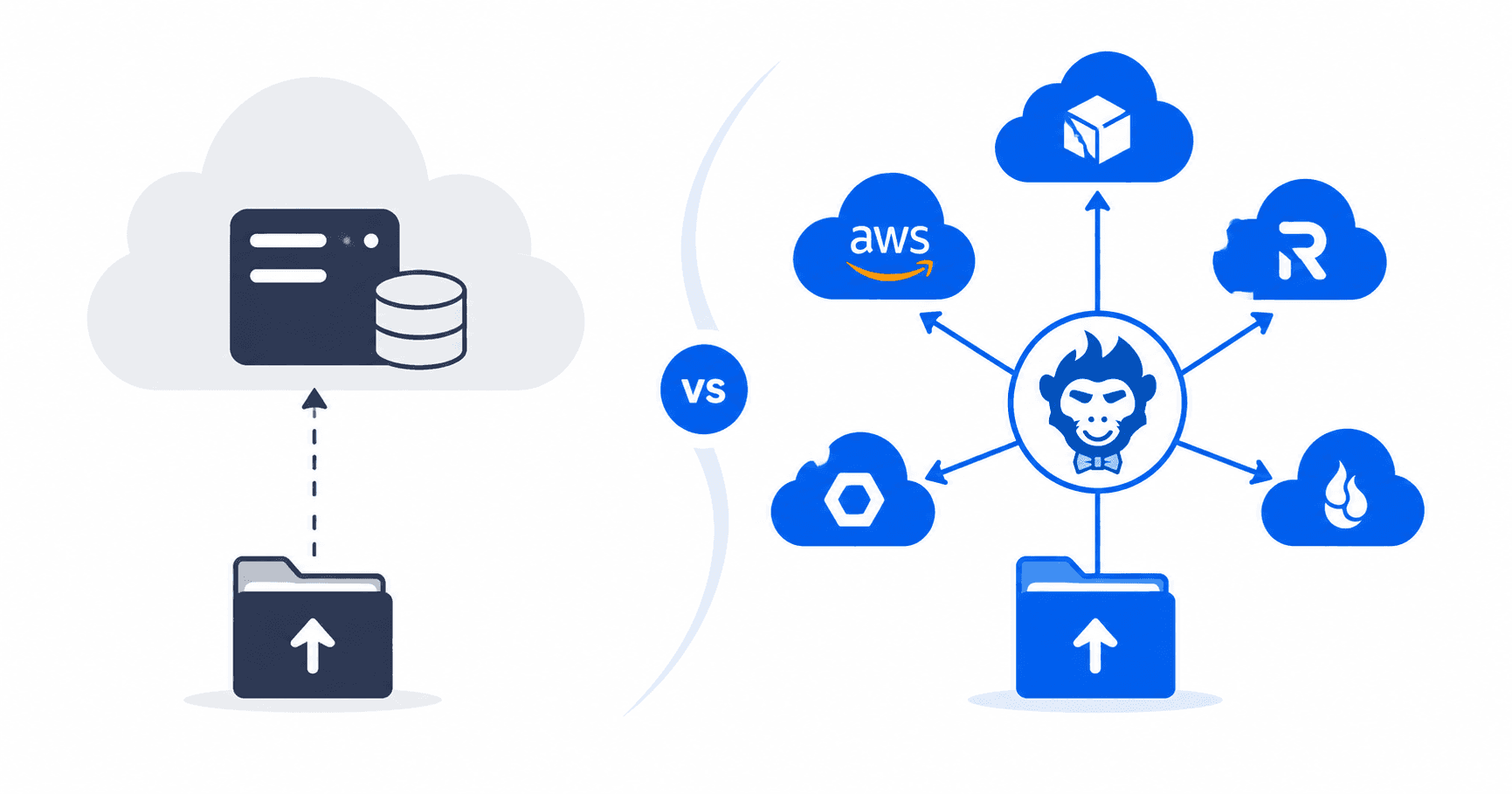
When you start shopping around for managed SFTP services, two names dominate every conversation: AWS Transfer Family and SFTPCloud. Since you ended up on our site, you're likely considering Rilavek as well. While all three solve the basic problem of receiving partner uploads over legacy protocols, their underlying designs couldn't be more distinct. So instead of running through a boring feature checklist, let's look at what each architecture actually obligates you to run.
Full disclosure upfront: we built Rilavek. Because of that, we're double-checking our numbers against published vendor rates and laying out exactly where AWS and SFTPCloud outshine us.
Three Fundamentally Different Designs
AWS Transfer Family acts as a bare protocol server. AWS handles the low-level SFTP, FTPS, or FTP daemon. Everything else (IAM roles, user provisioning, custom auth via Lambda, and CloudWatch metrics) remains strictly assembly required. Think of it as raw cloud infrastructure rather than a turn-key product.
SFTPCloud functions as a managed gateway instance. You rent dedicated virtual servers backed by an intuitive control panel. By default, incoming files settle in storage managed directly by SFTPCloud, though you can bring your own bucket on any plan once you exceed the included storage. You're effectively buying a hosted application with traditional capacity tiers.
Rilavek operates as a pass-through bridge. External clients connect using standard protocols (SFTP, FTPS, FTP, or resumable tus HTTP uploads), but incoming payload bytes stream immediately into your own S3-compatible bucket. Whether that's AWS S3, Cloudflare R2, Backblaze B2, Wasabi, MinIO, or IDrive e2, data flows straight through. Nothing stays on our disks. It's an intelligent pipe, not a holding pen.
Where your files rest and how vendors meter their service dictate almost every operational headache down the road.
Pricing Models Compared
| AWS Transfer Family | SFTPCloud | Rilavek | |
|---|---|---|---|
| Primary cost driver | Provisioned protocol hours | User accounts and server instances | Total bandwidth transferred |
| Base entry fee | ~$219/mo (single protocol, 24/7) + $0.04/GB | €39/mo (5 users, 1 instance) | Free (10GB/mo) |
| Typical small team bill | $220 to $450/mo | €39 to €99/mo | $0 to $10/mo |
| Cost during silent periods | Full monthly rate | Full monthly rate | $0 |
| Free tier offering | None | Limited trial | 10GB/mo (no credit card required) |
How does that break down in practice? Here are the numbers verified for 2026:
- AWS Transfer Family bills a flat $0.30 per hour for every protocol endpoint you spin up. Keep one SFTP server running constantly, and you're paying around $216 to $223 a month before moving a single byte. Add $0.04 per gigabyte in data transfer fees, plus minor extra charges for CloudWatch logging, secrets storage, and authentication Lambdas. Want to see where all those line items come from? We broke down a sample invoice in our guide on AWS Transfer Family pricing.
- SFTPCloud ties pricing directly to user seat count and instance slots. The Lite plan starts at €39/month for 5 users, bumping to €49 for 15 users, €99 for 50 users, and scaling up to enterprise tiers. If you need to grant access to 20 external contractors who only upload one file per quarter, you're forced onto a higher plan simply because of seat caps.
- Rilavek charges strictly for data moved through the pipe. Every account gets 10GB free every month. Beyond that, the Starter plan gives you 100GB for $10/month, while Pro covers 1TB for $30/month. We don't cap user accounts, server instances, or active connections. If you route an upload to two separate storage buckets simultaneously, we count the transferred bandwidth twice. That's literally the whole billing logic.
Setup Effort and Operational Overhead
How much engineering time will this take to maintain six months down the road?
AWS Transfer Family: Initial provisioning takes twenty minutes, but configuring user management takes days. Standard setup requires mapping IAM roles, scoping bucket paths, and importing SSH keys per user. Need simple password authentication? You'll have to write and maintain a custom API Gateway and Lambda integration. Diagnosing a failed upload requires digging through CloudWatch log groups. It's legitimate DevOps work that demands ongoing maintenance.
SFTPCloud: Exceptionally straightforward. You spin up an instance, invite users through a clean web dashboard, and hand over credentials. They also carry turnkey compliance credentials like ISO 27001. For enterprise procurement departments that won't sign a deal without certification badges, that convenience often ends the search right there.
Rilavek: Setting up takes about two minutes. You define a routing pipe, connect your object bucket (see our S3 setup guide), and generate credentials for your partners. Onboarding a new client simply means generating a new sender key. You get clear audit logs showing exactly who uploaded what without having to build custom telemetry pipelines.
Where Each Solution Shines
Choose AWS Transfer Family if you need:
- Strict isolation within your AWS perimeter, including native VPC endpoints, custom KMS keys, and IAM policies.
- Tight orchestration with AWS services like EventBridge triggers, Step Functions, and automated Transfer Workflows.
- The reassurance of selecting the default enterprise standard during vendor reviews.
Choose SFTPCloud if you need:
- Off-the-shelf compliance certifications ready to hand to your security review board.
- Built-in storage included directly on the platform without setting up cloud accounts.
- A traditional, user-friendly managed SFTP admin panel.
Choose Rilavek if you need:
- Predictable pricing for irregular traffic: You pay nothing for idle endpoints, and small projects fit comfortably inside the free tier.
- Backend flexibility: Connect any S3-compatible storage layer now, and switch destinations later without disrupting external partners.
- Parallel multi-bucket fan-out: Stream a single incoming upload to multiple destinations simultaneously (such as S3 and Backblaze B2) with automatic retry rules. SFTPCloud has no equivalent, and AWS can only approximate this through post-upload Transfer Workflows restricted to same-region S3 buckets. Streaming one upload across different storage providers in a single pass is unique to Rilavek.
- Reduced data exposure: Because files stream through memory without hitting disk, your data processing footprint for GDPR and HIPAA compliance stays remarkably small.
- Instant integration events: Receive secure, HMAC-SHA256 signed webhooks (
X-Rilavek-Signature) the exact second a file upload finishes. Check out our webhook documentation for sample code.
Trade-offs and Honest Counter-Recommendations
We would much rather help you pick the right tool than push you toward a bad fit. Here is when you shouldn't buy Rilavek:
- Zero third-party transit requirements: If your InfoSec team insists that raw network traffic cannot leave your AWS VPC, go with Transfer Family. Rilavek acts as a streaming proxy, so while we don't store your files, traffic still flows through our infrastructure.
- Day-one compliance badges: If your corporate buyer demands an ISO 27001 certificate or an off-the-shelf BAA before signing off, SFTPCloud has that audit paperwork ready. Our security approach relies on zero-disk architecture rather than pre-packaged compliance certificates.
- All-in-one hosted storage: If you want your SFTP platform to double as a file manager with web browsing, manual file sharing, and retention rules, you need a full hosted product like SFTPCloud rather than a stream-through gateway.
The Bottom Line
Deciding comes down to two questions: where should your data live, and how do you prefer to pay? If you want files inside your AWS perimeter and don't mind paying $200+ a month plus engineering time to manage IAM and Lambdas, pick AWS Transfer Family. If you want a complete turnkey server with user seats and audit certificates, pick SFTPCloud. But if you already have S3-compatible storage and simply want a lightweight bridge that charges for actual usage, Rilavek is built for you.
Further Reading
- Detailed Head-to-Head Comparisons: Read our breakdown of AWS Transfer Family vs Rilavek or SFTPCloud vs Rilavek.
- Exploring Options: Compare AWS Transfer Family alternatives for small teams.
- Choosing Protocols: Unsure which protocol to mandate for clients? Check our guide on SFTP vs FTPS vs FTP.
Enjoyed this guide?
Share it with your network to help others scale their data pipelines.