Raw gigabyte storage pricing is rarely where your cloud bill goes wrong. The hidden surprises in object storage almost always come from three distinct line items: egress fees, API operation charges (PUT/GET requests), and the ingestion gateway needed to accept uploads from external clients.
Use the interactive calculator below to model your storage footprint, expected downloads, and ingestion protocols. Compare true monthly costs across Cloudflare R2, Backblaze B2, Wasabi, IDrive e2, DigitalOcean Spaces, and AWS S3 in real time.
S3 Storage & Ingestion Architecture Sizer
Compare S3 storage, egress, and API costs across all major providers.
S3 Monthly Cost Comparison
Estimated monthly bill based on your storage and operations above.


Let users upload gigabyte files from browsers and mobile apps
Low-cost S3 buckets store your files. Rilavek eliminates the engineering headaches and infrastructure fees required to get data from external uploaders into your bucket.

Why Large Web Uploads Break
Direct uploads to S3 from the browser require backend presigned URL coordinators, brittle CORS headers, and custom chunk retry code. When mobile users switch cell towers or enter elevators, uploads fail and restart from zero.
- Spotty mobile connections and Wi-Fi drops force users to restart uploads from scratch
- Direct browser uploads to S3 fail on expired tokens and complex CORS configurations
- Building custom chunk retry logic delays shipping your actual product
Effortless Large File Ingestion
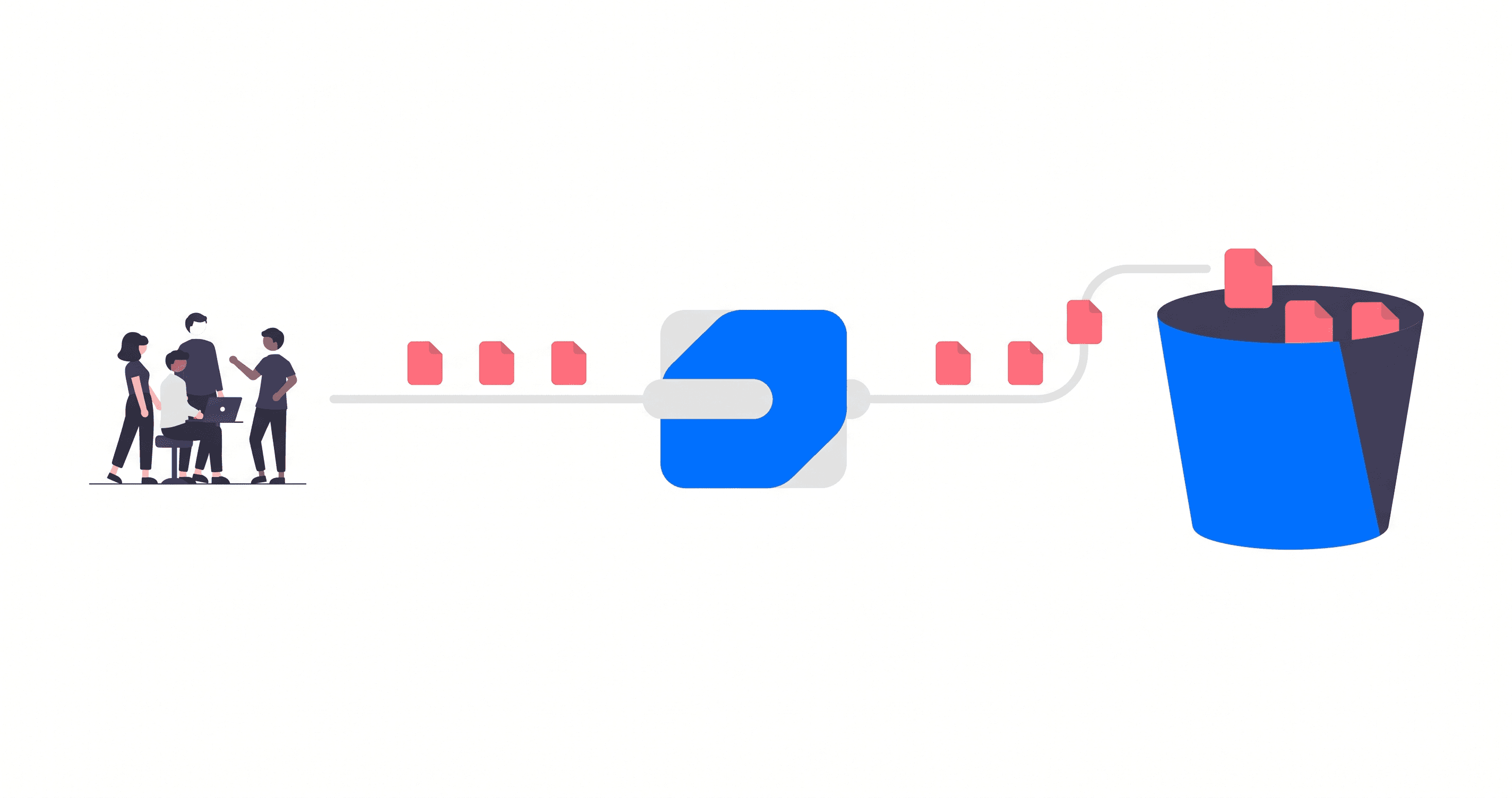
Rilavek exposes an open Tus endpoint compatible with Uppy and standard HTML forms. Large media files upload with automatic pause and resume, streaming in real time through memory directly to your bucket with zero disk exposure and instant HMAC-signed webhooks.
- Uploads automatically pause and resume across network drops without losing progress
- Users can reliably upload multi-gigabyte videos and files from any browser or phone
- Instant alerts notify your application the second an upload finishes
How the Cost Models Compare
Understanding how each provider bills for your workload prevents painful monthly billing surprises. Here is how the numbers break down behind the calculator:
1. Cloudflare R2: The Zero Egress Standard
- Storage: 10 GB free forever, then $0.015 per GB/month.
- Egress: $0.00 always. Cloudflare does not charge for egress, period.
- API Requests: 1,000,000 Class A (writes) and 10,000,000 Class B (reads) free per month. Additional writes cost $4.50 per million.
- Best for: Web applications, user media distribution, public downloads, and workloads where traffic spikes could otherwise trigger unpredictable bandwidth bills.
2. Backblaze B2: The Rock-Bottom Storage Winner
- Storage: 10 GB free forever, then $0.006 per GB/month (less than half of R2, and a quarter of AWS S3).
- Egress: Free downloads up to 3x your average monthly storage volume. Beyond that threshold, egress is billed at a modest $0.01 per GB.
- API Requests: Class A calls (PUTs) cost $0.005 per 10,000 calls.
- Best for: CCTV video archives, database snapshots, system backups, and write-heavy workloads that are read infrequently.
3. AWS S3: Enterprise Breadth with Heavy Surcharges
- Storage: $0.023 per GB/month for standard tier (nearly 4x the price of Backblaze B2).
- Egress: $0.09 per GB to the public internet after the first 100 GB.
- API Requests: $0.005 per 1,000 PUT requests ($5.00 per million, more than 10x Cloudflare).
- Best for: Workloads already deeply integrated into AWS VPCs, Athena, and AWS IAM policies.
4. Wasabi & IDrive e2: Zero-Egress Flat Storage
- Wasabi: Flat $0.0069 per GB/month with zero egress fees and zero API request charges.
- IDrive e2: $0.004 per GB/month with zero egress fees (up to 3x monthly storage) and zero API request fees.
- Best for: Predictable monthly budgeting without calculating separate operation or egress bills.
5. DigitalOcean Spaces: Bundled Bandwidth with Built-in CDN
- Storage: $5.00/month base tier includes 250 GB storage and 1 TB outbound transfer. Additional capacity costs $0.02 per GB/month ($20/TB).
- Egress: 1 TB included each month. Overage is billed at $0.01 per GB.
- API Requests: Free. DigitalOcean doesn't bill for PUT, GET, LIST, or multipart operations.
- Best for: Teams already running Droplets or Kubernetes workloads who want unified bills, edge CDN caching, and no per-request arithmetic.
The Hidden Ingestion Cost: Why Gateways Matter
Many teams pick their object storage, set up their buckets, and then hit an unexpected architectural blocker: external sources do not speak the AWS S3 SDK.
Security cameras, NVRs, legacy accounting tools, and external vendor partners frequently upload files via SFTP, FTPS, or standard FTP. Browser web apps often require resumable Tus uploads so users can upload large videos without custom backend servers.
Here is how solving that ingestion problem impacts your total cost:
- The AWS Transfer Family Route: AWS charges a mandatory $0.30 per hour ($216 per month) endpoint fee just to keep an SFTP server active, plus $0.04 per GB of transferred data on top of standard S3 storage and API fees. A modest 250 GB backup feed costs over $230/month on AWS.
- The Rilavek Pass-Through Route: Rilavek sits in front of your chosen bucket as a managed, zero-disk ingestion bridge. It accepts SFTP, FTPS, FTP, and resumable Tus uploads in memory and pipes them straight into your Cloudflare R2, Backblaze B2, or self-hosted bucket. Rilavek's free tier includes 10GB/month with no credit card required.
Next Steps
- Set up a Cloud Gateway: Connect your free Cloudflare R2 or Backblaze B2 bucket in minutes with our S3 Data Stores Guide.
- Self-Hosted Breakdown: Compare RustFS, SeaweedFS, and Garage in our Self-Hosted S3 Storage Comparison.
- Browser Uploads: Implement plug-and-play resumable uploads from React or Next.js using the TUS Browser Upload Guide.
Enjoyed this guide?
Share it with your network to help others scale their data pipelines.